
What changed
Back to Demand
GEO · Generative Engine Optimization
Your buyer asked ChatGPT for a shortlist. You weren't on it.
AIMER shows where AI recommends you, where competitors get cited instead, and which buyer questions you're missing. We turn those gaps into your GEO plan.
Free · Results in under three minutes · No sales call
Google's AI Overviews works differently — it runs on your rankings. That's covered under AI SEO.
AIMERAI Command Center · AIO & GEO
QUANTALOOM · SAMPLE DATA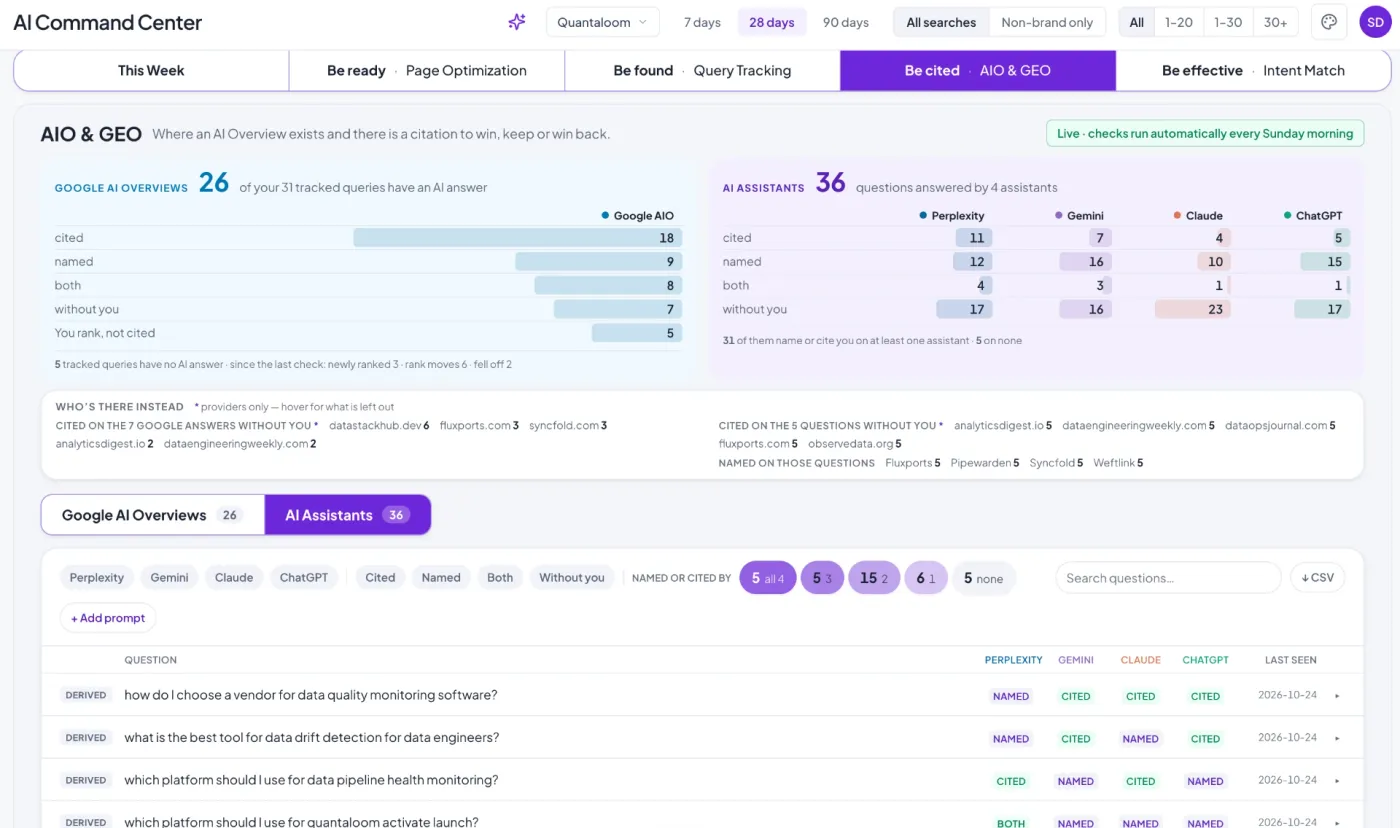 Expand dashboard
Where AI cites you, names you, or leaves you out — across Google AI Overviews and every major assistant.
Explore AIMERSince 2015
Eleven years running enterprise search
5 assistants
ChatGPT, Perplexity, Gemini, Claude, Copilot — tracked weekly
B2B focus
Technology, telecom and education buyers
Own tool
AI Marketing Radar, not a spreadsheet
01
Lap 01/07 · The shift
Ten links was a shortlist. One answer is a decision.
A results page let your buyer choose. An assistant chooses for them, then explains why — in its own words, which may or may not be yours. If you aren't in the answer, you aren't in the evaluation. If you are in it and the description is wrong, that is worse. Either way you never see the loss: there is no impression to count and no click that didn't happen.
What it costs you
You drop out of evaluations you were never told about. No impression, no click, no trace in your reporting.
What wins now
Being named in the answer — and described the way you would describe yourself.
02
Lap 02/07 · Be cited
Getting named isn't a content problem. It's a consensus problem.
Assistants don't read your website and form an opinion. They assemble one from everywhere you appear — Reddit threads, G2 entries, Wikipedia, YouTube, trade press, “best X for Y” listicles. Your own site is one input among many, and often not the loudest.
So the work runs in two places at once.
On your pages
Answers short enough to lift, schema a machine can read, one unambiguous statement of who you are, what you sell and who you sell it to.
Off your pages
Presence and consistency in the sources engines actually cite. Closer to digital PR than to SEO — and the target list is different. We go where the engines go.
What we run, weekly
A fixed set of the questions your buyers really ask, put through ChatGPT, Perplexity, Gemini, Claude and Copilot. We track three things: whether you're named, where in the answer, and whether the description is right.
01
Buyer question set
The real questions your buyers type, built from sales calls, Search Console and People Also Ask — not keywords.
02
Answer-shaped content
Short, self-contained answers an engine can lift whole. If a paragraph needs the one before it, no engine will use it.
03
Entity and schema clarity
One consistent statement of who you are, marked up so a machine knows what it is reading.
04
Third-party consensus
Presence and accuracy on the sources engines cite — review platforms, trade media, community, reference sites.
05
Crawler access
OAI-SearchBot, PerplexityBot and ClaudeBot can reach what matters and are blocked from what shouldn't be quoted.
06
Misdescription repair
Where an engine has you wrong, we find the source it learned from and fix it there.
03
Lap 03/07 · Be ready
Being cited is worth nothing if the page they land on can't close.
AI traffic arrives differently. Lower volume, far higher intent, and already half-convinced by whatever the engine said about you. A page built for a cold Google visitor wastes it — it re-explains what the assistant already covered and asks for a form fill before earning one.
- 1The claim the engine made — confirmed and evidenced in the first screen.
- 2The objection it couldn't answer — handled next.
- 3One action — sized to where they actually are in the decision.
Most agencies stop at the citation and let your existing page absorb the traffic. We don't.
04
Lap 04/07 · Be effective
So how would you know any of this is working?
Four numbers, baselined before we start.
In week one you see, in your own data, which questions you lose and what the engines currently say about you. That's the baseline every result is measured against.
01
Share of answer
A fixed question set run weekly across all five assistants. Score = how often you are named, and how high in the answer.
02
Accuracy of description
What the engines say about you, not just whether they speak. Wrong beats silent, and it is fixable.
03
AI traffic in your GA4
A custom channel for ChatGPT, Perplexity, Gemini, Claude and Copilot, so AI visits stop hiding inside “referral”.
04
Pipeline, not pageviews
Form fills, demo requests and deals tied back to the engine and the question that sent them.
Read-only access to your analytics. We never change your setup, and you can disconnect at any time.
One live view in AI Marketing Radar — share of answer, accuracy and conversions in one place. No waiting for a monthly report.
Explore AI Marketing Radar05
Lap 05/07 · Proof
Real proof · Digital infrastructure
15X
ROI
$2.4M+
qualified pipeline
Enterprise Cloud Provider
The problem
Strong Google rankings. Nearly invisible when buyers asked AI for sovereign cloud options.
What we did
Rebuilt priority pages around real buyer questions, fixed schema, and tracked the gap weekly in AI Marketing Radar.
One recent 6-month engagement. Results vary by starting point and market.
06
Lap 06/07 · Why Markiverse
Most GEO agencies were founded last year. Most SEO agencies are still optimising for ten blue links.
GEO pure-plays have novelty and no search depth. Traditional agencies have depth and no AI practice. We have eleven years of enterprise search and our own tooling.
| Traditional SEO agency | GEO pure-play | Markiverse | |
|---|---|---|---|
Track record | Years of search, no AI practice | Founded in the last year or two | Eleven years of enterprise search, AI practice built on top |
Tooling | Rank trackers | Spreadsheets and manual prompt checks | AI Marketing Radar, our own product |
What they measure | Rankings | Whether you are mentioned | Whether you are mentioned, where, and whether it is accurate |
Evidence shown | Case studies | Testimonials | A quantified case: 15X ROI, $2.4M pipeline |
Example data | — | Dashboards shown without labels | Every illustrative figure on this site is labelled as illustrative |
07
Lap 07/07 · Questions
What buyers ask about GEO.
01
What is GEO?
Generative Engine Optimization is the work of getting a brand named, and described correctly, in the answers AI engines generate. It covers every generative engine, Google's AI Overviews included. We cover Overviews under AI SEO, because winning one depends on ranking first — different work, different page.
02
Is GEO the same as SEO?
No. SEO gets you found — you are in the running at all. GEO gets you named in the answer. SEO is the foundation: an engine that cannot crawl or understand your site cannot recommend it either. But ranking well and being recommended are now two different outcomes.
03
Is GEO the same as AEO?
They overlap. AEO is a method — writing and marking up a page so a machine can lift an answer out of it. GEO is the wider practice of being present and accurate across generative engines, including on sources you do not own. AEO is part of how we do GEO.
04
Why doesn't AI mention my brand?
Usually one of three reasons. The engines cannot find a clear answer on your site. Or they can, but the sources they trust — review sites, community, trade press — do not mention you. Or they mention you and get you wrong. The scan tells you which.
05
How long does it take?
Branded questions and narrow niches often move within weeks. Competitive category questions take months, because they depend on third-party consensus that has to be earned rather than published. Anyone promising a fixed timeline across both is guessing.
06
How do you measure it?
Four numbers, baselined before we start: share of answer, accuracy of description, AI traffic isolated in your GA4, and pipeline tied back to the engine that sent it.
07
Which engines do you track?
ChatGPT, Perplexity, Gemini, Claude and Microsoft Copilot, weekly. Google AI Overviews is tracked under AI SEO.
08
What does the free scan include?
Your brand run against a set of real buyer questions across all five assistants, showing where you are named, where a competitor is named instead, and where you are described inaccurately. Under three minutes, no sales call.
Every week you wait, AI recommends someone else.
Find out what the five assistants say about you today — named, missed, or described wrong.
Under three minutes. No sales call.
The rest of the engine